11:11PM - 01.06.'15
|
News Source: autoblog.com
|
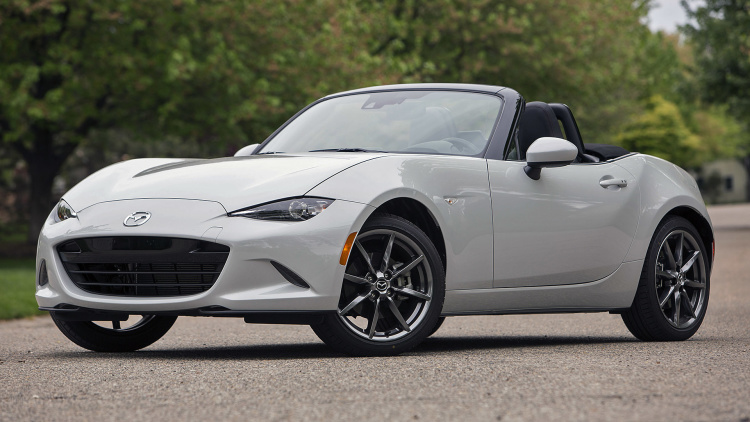
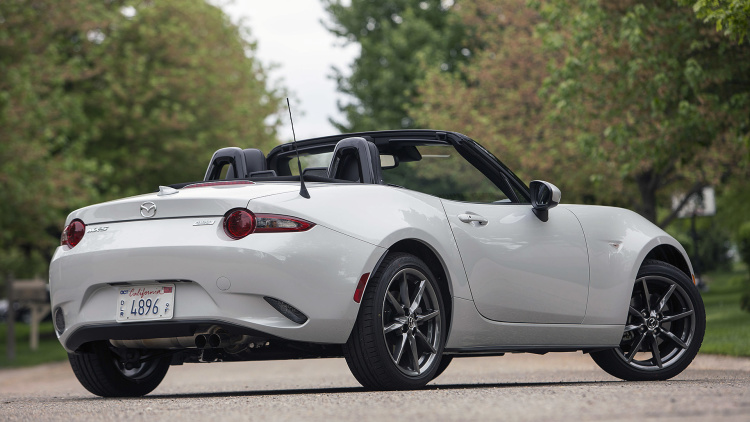
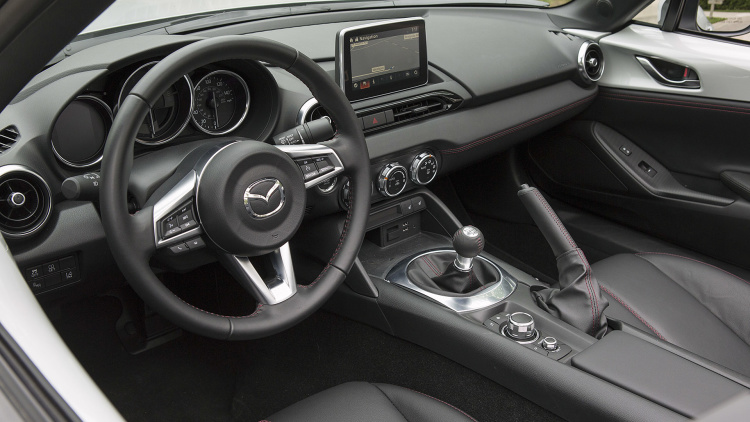
The 2016 Mazda MX-5 Miata is easy to comprehend. It is an enthusiast roadster in its purest form. There's no need for any sort of sales pitch. You don't have to ramp up in order to get people excited about it. Say the words "new Miata" to anyone who cares about cars, and you've immediately got their attention. And now that I have yours, I'll to cut right to the chase. It's brilliant. That's a fact I've known for a while. I drove the Japanese-spec ND Miata in Spain earlier this year, with the 130-horsepower, 1.5-liter engine that we aren't getting in the United States. The new Miata is a modern day reincarnation of the original NA that stole our hearts in 1989. It's smaller and lighter than the outgoing NC, yet boasts more interior room. It's comfortable. It looks great. And it drives like a Miata should. In other words, it's perfect. So what about this US-spec car, then? It's got more power – 155 horsepower and 148 pound-feet of torque from Mazda's 2.0-liter Skyactiv four-cylinder engine. But it's also heavier. Our car weighs 2,332 pounds, compared to the roughly 2,200 pounds of the 1.5-liter car. Yes, the ND Miata loses 12 hp compared to the outgoing NC, but it's up 8 lb-ft of torque. Plus, according to Mazda, because of the improved powerband, anytime you're under 5,700 rpm the new Skyactiv engine is stronger than the old MZR mill. It's more efficient, too. With the manual transmission, the Miata is estimated to achieve 27 miles per gallon in the city and 34 mpg highway. That a jump of six mpg in both categories compared to the old six-speed. Consider this: The Japanese-spec car uses a 130-hp engine, which I found to be perfectly adequate. The increase in power for the US-spec car mostly just balances out the extra weight, but it also improves performance on the highway. Hit the throttle in sixth gear with the 1.5 and nothing happens. Do the same with the 2.0, and there's movement. Low-end power is far more important in the US than it is in other markets, and that's why our car has the larger engine. "North America is why the two-liter car exists," engineer Dave Coleman told me. Plus, 155 hp power means you eke out the Miata's dynamics at legal speeds. 45 miles per hour in an MX-5 is a far more exhilarating experience than that same speed in any supercar. So yeah, it's not powerful. But to paraphrase Jay-Z, the MX-5 is a super car, not a supercar. Having driven both versions of the Miata, I can say that the added weight makes little to no difference in overall performance. The final curb weight number isn't the main focal point. Instead, concentrate on how the MX-5 throws its weight around. It's perfectly balanced – 50/50, front to rear. Moreover, the car was designed around the driver. No, really. That's not just marketing speak. Engineers started with the driving position and located the other components accordingly. The weight and balance translates to excellent involvement from behind the wheel. Compared to the outgoing NC Miata, the driver sits 20 millimeters lower to the ground, and 15 millimeters closer to the center of the car. The Miata's center of pitch is more rearward, in line with the driver's head. When the car squats under hard braking, your eye point remains stable. And the brakes don't bite hard during initial application. The driver-centric logic applies to every facet of the Miata's operation. When the car exhibits some of its classic roll in turns, your body stays put. You never have to wonder how much weight is being transferred to any corner, because you feel it. Truthfully, you get feedback more through the suspension than the steering. Distinct road feel isn't as present through the wheel of the ND Miata, neither is on-center weight. But this was done deliberately. With the previous Miata, stronger buildup around center meant less feel at higher Gs. Instead, the electric power-assisted setup is more progressive in how it builds weight. Steering response is less like you're simply controlling the movements of the front wheels, rather, the entire car rotates around you. That connection extends to the six-speed manual transmission. Yes, an automatic is available, but that's not what you want. A stick-shift heightens the engagement of the Miata experience, and Mazda's do-it-yourself tranny is great. Clutch action is light and linear. Throttle response is as well, so you're never giving it too much juice off the line in first gear, though it's easy to blip and rev match for downshifts. The shifter itself is small, and is placed close to the driver. Changing gears is a quick action, with appropriately short throws between each cog. In the Miata I feel incredibly confident behind the wheel. I know exactly how the roadster will respond to every command, and I use that to my advantage. I provoke the rear end to step out around a slow corner, the car snaps back in line with the same rate of my corrective inputs. My eyes look ahead into a corner, my arms move the wheel accordingly, the car responds with quick, yet predictable turn-in and roll. I cannot stress it enough: The relationship between car and driver is stronger in the ND Miata than perhaps any vehicle I've tested in recent years. I'm not just talking about the driving experience, either. The same goes for specific elements of the Miata's cabin. For example, the pedal box is deep enough that even taller drivers will have no problem fitting inside. The seats are comfortable and supportive, but aren't so strongly bolstered that the driver will struggle to turn around while operating the folding top. Mazda measures effort on that sort of thing – seriously. And before you ask, no, the company hasn't said anything about the availability of a power hardtop in the future. |