09:02PM - 06.06.'15
|
News Source: autoblog.com
|
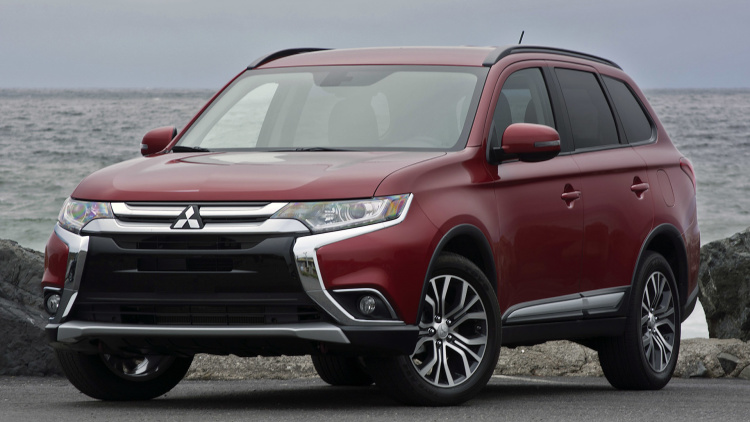
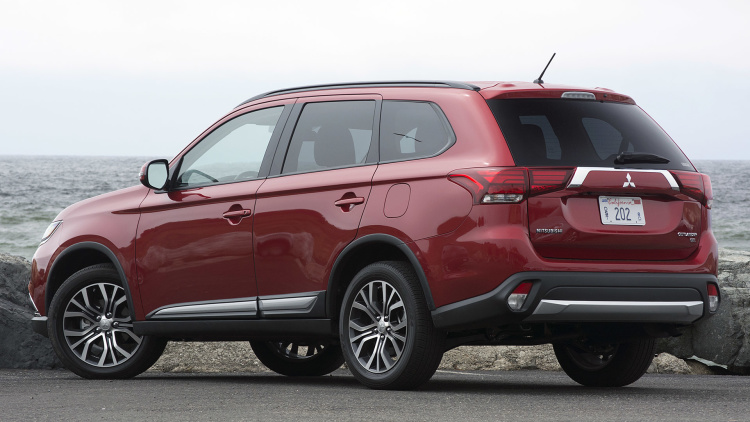
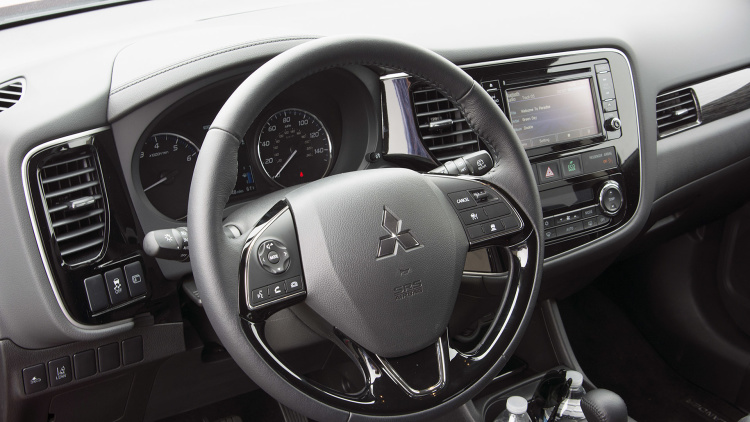
"There is a golden hour between life and death. If you are critically injured you have less than 60 minutes to survive. You might not die right then; it may be three days or two weeks later – but something has happened in your body that is irreparable." That quote is from Dr. R. Adams Cowley, widely viewed as the father of modern-day trauma medicine. It's an apt description of the straits Mitsubishi finds itself in here in the United States. The company's golden hour has been a long time coming, but with the death of the Lancer Evolution, and a stable that consists of the ancient Lancer, the lamentable Outlander Sport and the abhorrent Mirage, the 2016 Outlander marks the start of this vital 60 minutes. It was with this in mind that we shipped out to San Francisco to test the company's latest compact CUV. Technically a facelifted version of the crossover that debuted at the 2012 Los Angeles Auto Show, Mitsubishi made over 100 changes as part of this refresh. The exterior changes strip away some of the Outlander's boring, conservative elements in favor of a new design language called "Dynamic Shield." Most of the work is from the A-pillars forward, where an assertive chrome-lined grille, restyled headlights, and a new hood are found. Larger LED taillights sit in back, along with chrome elements. As is the fashion nowadays, LED running lights have been added as standard, while the GT gets LED low beams and halogen high beams, as well. The cabin receives similarly small upgrades, updated materials, and a new navigation system. Plastic is the dominant surface, although it's no better or worse than the stuff usually encountered in this segment. Mitsubishi added piano-black accents on the bottom half of the leather-wrapped steering wheel and around the touchscreen navigation system, to class up the cabin. The cloth seats on the entry level models have also been updated, although the leather on the mid-range SEL and top-of-the-line GT we drove is unimpressive. The same can be said of the seats themselves, which are wide and unsupportive, particularly if you suffer from lower back issues, as your author does. You'll get eight-way powered adjustments on the SEL and GT, although lesser trims get by with manually-operated, six-way adjustability. Neither of those setups include lumbar adjustments. The steering wheel tilts and telescopes, at least, regardless of trim level. A standard third-row of seats has long been one of the Outlander's strongest points. They fold flat and can be raised and lowered in an instant. They're not supremely comfortable for long periods, although they might not bother the shorter members of your brood. Mitsubishi also reworked the second-row seats, listening to consumer complaints about their ease of use, or lack thereof. We found them to be plenty easy in practice. Outlander shoppers can choose from a pair of engines. The base 2.4-liter four-cylinder will power the overwhelming majority of crossovers, seeing as it's the only engine offered on three of the four available trims. It generates 166 horsepower and 162 pound-feet of torque, with peak output coming at 6,000 and 4,200 rpm, respectively. On the way to those numbers, it returns 31 miles per gallon on the freeway and 25 mpg in the city. Yes, that's disappointing, but it's nothing compared to the lamentable output of the GT-only 3.0-liter V6. That engine delivers just 224 hp and 215 lb-ft of torque, and as a further kick in the teeth, demands premium fuel on the way to a 20-mpg city and 27-mpg highway ratings. None of this is particularly good, especially when the Honda CR-V and Jeep Cherokee's naturally aspirated four-cylinders pump out 184 hp each, the V6s in the Cherokee and Chevrolet Equinox churn out 271 hp and 301 hp, and the 2.0-liter, turbocharged four-cylinder of the Ford Escape offers 240 hp. Simply put, the Outlander is outgunned by just about everyone. The 2.4-liter is paired with a new CVT, which originally debuted on the 2015 Outlander Sport. While front-drive is standard, Mitsubishi's Super All-Wheel Control system can be paired with the four-cylinder/CVT combo. As for the V6, it's offered with all-wheel drive and a six-speed automatic, only. Despite its modest figures, the four-cylinder is an able companion. It sounds pleasant, but strained when working hills. That's no surprise, considering the nearly 3,500-pound curb weight of our SEL S-AWC tester. On flat ground, though, its output is adequate, particularly from a standstill, where the quick-to-engage transmission is responsive to throttle inputs. In the hillier sections, the CVT keeps the revs up as long as needed, meaning the four-cylinder Outlander actually felt more responsive than its six-cylinder brother. Speaking of that six-cylinder, unless you absolutely need its 3,500-pound tow capacity – 2,000 pounds more than the four-cylinder – it's to be avoided. It's slow to rev, sounds rough and unrefined, and aside from action at freeway speeds, never quite has the grunt you expect. The six-speed automatic executes relaxed upshifts and tends to hunt for downshifts. Taking hold of the Evo-derived, column-mounted paddles livens up the process, although we aren't sure if this would be reflected on a stopwatch or if it's simply our imagination. Mitsubishi reinforced the front crossmember for improved rigidity, and also retuned the front shocks. The rear springs were also stiffened, and a larger cylinder was fitted to the back shocks. Body rigidity was also improved by adding more bracing. The result of these changes is a much-improved handling character compared to the 2015 model and a quieter ride. And yet, this is a vehicle that simply can't hold a candle to the best dancers in this segment. The V6 Outlander's handling ability is especially mediocre. It feels heavier and clumsier through the bends, even though the V6 only adds 100 pounds of fat. It's nose heavy and wants to push through turns. It rolls and dives hard, too. The four-cylinder is a far better companion. It's more neutral and willing to turn in, and while its weight distribution is virtually identical – 56/44 to the V6's 57/43 – it felt better balanced on corner entry and mid-way through the turns. |