|
News Source: autoblog.com
|
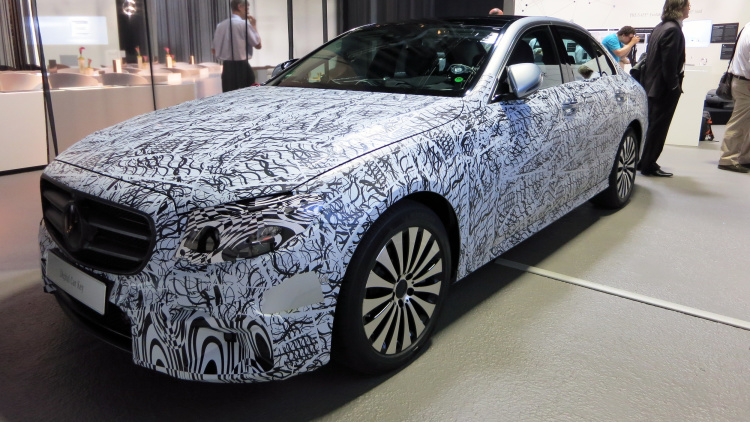
If there's a theme to the next Mercedes-Benz E-Class, it's technology stuff. No "and," no hashtag. Just technology stuff. The car is so loaded with new and updated features that it eclipses the S-Class as the brand's leading edge automobile just two years after the flagship's debut. The world of automotive technology is progressing at an exponential rate akin to Moore's Law, and the E-Class is at the front of the curve.
For the sake of brevity (and totally not for SEO gamesmanship), the 2017 E-Class has so many new and improved features we're just going to list them: remote control parking via a smartphone app, NFC-based unlock and vehicle start using your smartphone, 84-LED adaptive headlights, Vehicle-to-X communication, evasive maneuver assistance that identifies pedestrians and helps you steer away from danger, adaptive cruise control that sets the speed based on road signs, adaptive steering that can follow a car in front even without lane markings, active emergency braking for cross-traffic, rear-seat seatbelt airbags, an air bladder that pushes front-seat occupants towards the center of the car before a side impact, and an audio system that triggers your eardrum's reflexes to prevent hearing damage in a crash.
And that huge list is all we know so far – Mercedes hasn't talked about powertrain, chassis, or infotainment yet. We're also told that all of these features will be available when the E-Class comes to the States early next year. Unlike other automakers, which save the fancy tech for Europe, Mercedes will give us all the goodies. Here's a breakdown of each item.
Park By Smartphone
Mercedes calls its autonomous parking Park Pilot, and it's similar to the remote control parking recently shown on the BMW 7 Series. The benefit of both systems is that you can fit into a space that might otherwise be too tight to open the doors. The Bimmer uses a key fob, while the E-Class works with a smartphone app. Finding a perpendicular or parallel parking space starts inside the car by activating the parking system. Once a spot is found, the process can continue outside the car at any point in the process, as long as the smartphone is within ten feet of the car. The app makes you draw a circle on the phone screen to run the car through its movements. See a demo in the video above.
Leaving a parking space is done via a similar process, although the driver doesn't need to get into the E-Class to make it pull out of a spot. It also features Explore Mode, which can pull straight ahead or backward into a garage space and make adjustments – you know, to avoid your boxes of Beanie Babies and Furbies taking up so much space until the market rebounds. If space is extra tight, such as in a narrow two-car garage, Park Pilot will confirm a reduced lateral distance setting, fold the mirror, and squeeze the car in.
Look Ma, No Keys!
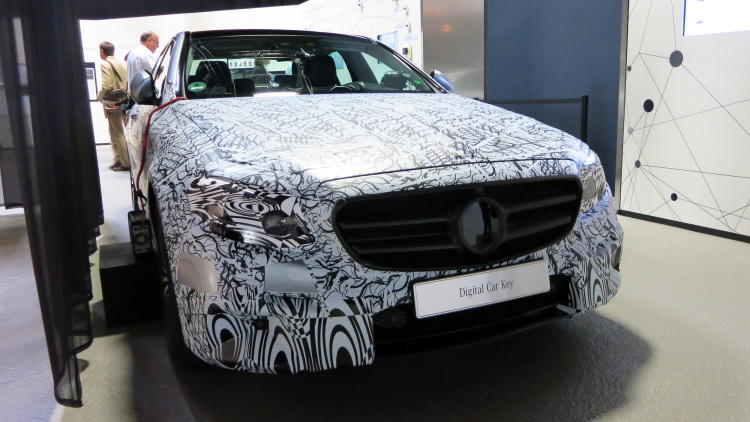
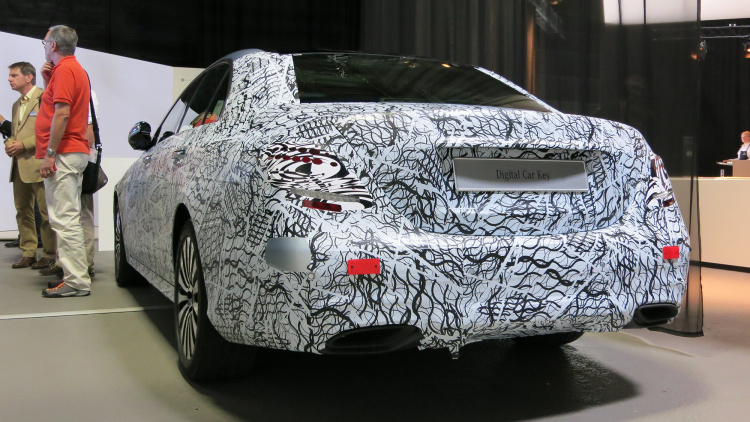
For some, the smartphone is the mark of the beast. For most of us, it's an essential part of our lives that gets cooler every day. And with the E-Class the smartphone can replace your keys. All you need is a phone with NFC (near-field communications), such as an iPhone 6, most recent Samsung Galaxies, and this writer's beloved BlackBerry. Tap the phone on the driver's side door handle to lock and unlock the car. Once inside, the phone sits in a cradle that also offers wireless charging, and the start/stop button responds to your whims.
The official literature from Mercedes mentions the need for a secure SIM card. The engineers we spoke with were certain that any phone with embedded security – like the kind that allows Apple Pay on iPhone – will work with the system regardless of any SIM card or carrier restrictions.
Lighting Up The Night
Each headlight on the new E-Class consistss of a single chip embedded with 84 light-emitting diodes. It's an evolution of the 24-LED system on the CLS-Class. The Multibeam adaptive light system works using a combination of its many light sources, without the need for any mechanical movement. This goes beyond a fancy start-up and shut-down pattern – the beams can spread wide for cornering and low-speed driving or dim specific sections to prevent blinding oncoming traffic. Again, we're told this system will be fully active in the US market, although the maximum distance might need to be adjusted downward to meet our antiquated vehicle lighting regulations.
In the rear the E-Class taillights dim at night to reduce glare for other cars on the road. As in the S-Class, the brake lights operate at 80 percent brightness at night compared to daytime, and drop down to 60 percent when the car is at a stop.
Talking To The Cloud
Vehicle-to-X is a term for smart communication between vehicles via a central server. Along with vehicle-to-vehicle communication it's a often-promised, yet-to-be-delivered technology for future transportation. Mercedes already offers this as an optional kit on the Euro-market A-Class, but the E-Class is the first model with the functionality hard-wired in. It uses the existing cellular communications module in the car to send and receive information about traffic and road conditions to a Mercedes server that shares the data with other nearby cars. If you experience a sudden slowdown, accident, or slippery road conditions, you tell the rest of the E-Class world in about two seconds. Drivers can also report roadside incidents via the infotainment system.
The major limitation, for now, is that this system is limited to the E-Class. If you're the only car in town, you won't get any benefit. But that data can be linked between automakers should other vehicle-to-X systems come online. It can also tap into government-based traffic reporting, and Mercedes is already in talks with several German states to add this functionality. In terms of privacy, Mercedes claims the system dumps all personal data as soon as a car is validated in the system – ill-intentioned hackers wouldn't even be able to tell the difference between and S-Class and an E-Class.
|


